
The idea is older than you might think, and it’s rooted in a surprising mix of bug-hunting, wartime necessity, and a love of long summer evenings. The modern concept was famously proposed by Benjamin Franklin in 1784, but not as a joke—he calculated that Parisians could save a fortune on candles by getting up with the sun. It wasn’t until World War One that Germany and Britain adopted it seriously to save fuel and boost war production.
A man named William Willett even campaigned for it in 1907, frustrated that he couldn’t go golfing in the lingering daylight after work. Willett’s campaign never succeeded in his lifetime, but his vision lives on every spring. Fun fact: he was the great-great-grandfather of Coldplay’s Chris Martin, so you can blame his ancestor for both the time change and “Yellow.”
The practical side (because it’s not all whimsy)
On the Saturday before the change, set your clocks forward before you go to bed—it’ll save you a bleary-eyed Sunday morning scramble. Your body, however, won’t be so easy to fool. That lost hour can mess with your circadian rhythm, leaving you sluggish for a few days. Go to bed 20 minutes earlier on Friday and Saturday nights to soften the blow.
Sunday morning will feel weird: your brain says 8 AM, but the clock says 9 AM. Get outside early into natural light; it resets your internal clock faster than any coffee. And please, be extra cautious if you’re driving that Monday morning—studies show a slight spike in road accidents after the spring forward, as tired drivers adjust.
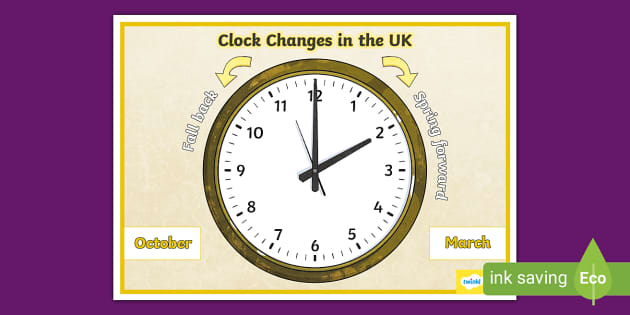 Clock Changes in the UK Display Poster
Here’s a tiny hack: brunch on Sunday. It’s a socially acceptable way to ease into the day at a leisurely pace, and it feels forgiving when your stomach is still on old-time. Pair it with a walk in a park where you can notice the daffodils and blossom that suddenly seem to be everywhere.
Cultural quirks and calendar trivia
The UK used to stay on Double Summer Time during World War Two, meaning clocks were two hours ahead of GMT in summer. Imagine that—sunset at nearly 10:30 PM in London. The experiment in 1968-1971 kept Britain on BST all year, but it was scrapped after dark winter mornings made schoolchildren walk to school in pitch black.
Today, the European Union debated abolishing the seasonal time change, but Brexit meant the UK can make its own decisions—and for now, we’re sticking with the tradition. “Spring forward, fall back” is so ingrained in British culture that weather presenters still get quizzed about it annually, and pubs enjoy a steady trade from disoriented punters. The only country that doesn’t observe it in these isles is Iceland, which stays on GMT all year because their summers are already ridiculously light.
 Do The Clocks Go Forward Or Back: Complete Guide & Key Details | TAFT
A bit of reassurance: the day after the switch is rarely the disaster we fear. Yes, you’ll yawn through your first meeting, but by Tuesday, you’ll wonder why you ever worried. The psychological payoff is real: longer evenings mean spontaneous garden drinks, evening runs without a torch, and the sense that summer is actually on its way.
The deeper reflection
At its heart, this annual ritual is a reminder that time is a human invention, as flexible as an elastic band. We arbitrarily decide to steal an hour from sleep to gift it to daylight, and somehow we all go along with it. That collective agreement is charming—a shared, slightly groggy nod that we value light over darkness, possibility over comfort.
So when you find yourself squinting at the late-afternoon sun on Sunday, feeling vaguely cheated of an hour of sleep, remember this: you’ve just helped nudge the whole country into a brighter season. It’s messy, it’s old-fashioned, but it’s also a gentle push toward the warmth we all crave. Embrace the yawn. Grab a coffee, open the window, and let the light in. The clocks have done their magic—now it’s your turn to soak it up.

