
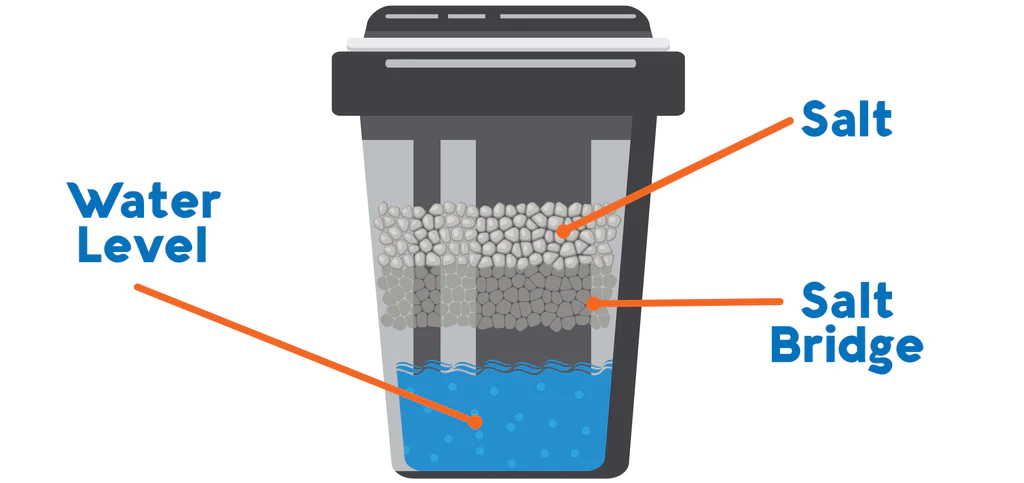
A salt bridge is exactly what it sounds like: a bridge of salt. It’s a hardened dome that forms across the surface of the salt in your brine tank, leaving a hollow gap beneath it. The pellets on top glue themselves together, usually because of high humidity or drastic temperature swings in your utility room. Think of it as a salt igloo built by very confused, very small construction workers.
Here’s the kicker: the water level sits below that bridge, so the salt can’t dissolve properly. Without dissolved salt, your water softener can’t regenerate, and your water turns back into the “hard” villain you were trying to defeat. Your hair will start squeaking again. Your dishes will look like they’ve been kissed by a ghost of mineral deposits.
Surprising fact: a salt bridge can be as tough as a sidewalk in winter. I’ve seen homeowners whack them with broom handles for twenty minutes and only manage to give the bridge a minor concussion. It’s a passive-aggressive monolith of misery.
How Do You Know You Have One?
You’ll notice your water getting hard again—soap won’t lather, your skin feels sticky, and your coffee maker starts building its own little coral reef. But the dead giveaway is looking into the salt tank and seeing a crust that looks like the top of a crème brûlée, but you can’t tap it with a spoon. Instead, you’ll have to poke it with a long stick or, if you’re brave, your bare hand (don’t—it’s sharp).
 Water Softener Not Using Salt? Here are 5 Reasons Why
If the top layer is solid but there’s liquid underneath, you’ve got a bridge. If the whole tank is a solid block, you’ve got a salt mushy, which is a different, stickier nightmare. But we’re talking bridges here.

