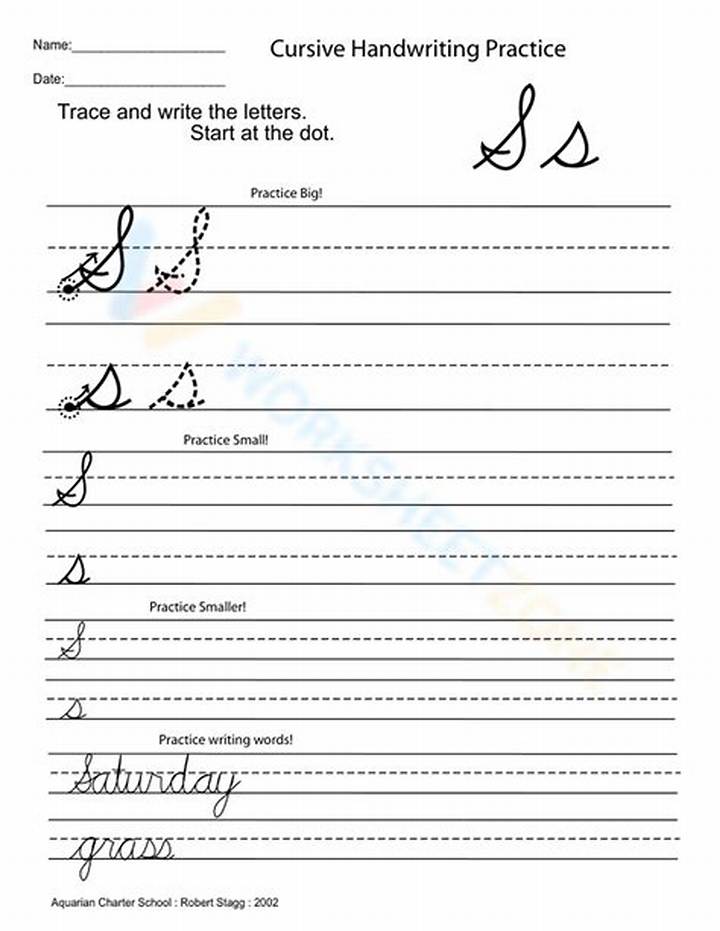
Here’s a reliable way to form a capital S that stays smooth and legible. The exact angle of your wrist may differ, but the sequence should feel natural.
Start with a clean entry
Begin near the top writing line (or slightly above it, depending on your guide). Use a light touch to start the motion. Many learners do better when they start with a short upward-and-right movement before committing to the main curve.
Form the upper curve
Smoothly curve to create the top “bulge” of the S. Keep your curve even—aim for a consistent rhythm rather than forcing the shape quickly. If you rush, you’ll often get a wobble at the top corner of the letter.
Transition through the middle turn
The middle of a capital cursive S is the key moment. Your stroke direction changes here, and your pen has to pivot without stopping. Practice the “turn” like it’s a gentle steering adjustment, not a sharp corner.
Build the lower curve and exit
After the middle turn, flow into the lower part of the S. Finish with a clear exit stroke—slightly angled to help the next letter connect in cursive. A messy exit often makes the whole capital S look unstable, even if the top half is correct.
If you want a quick self-check: your capital S should look like one continuous shape with two major curves (top and bottom) connected by a smooth central transition.

